Vapor phase reflow can reduce the risk of a head-in-pillow defect in dense PCBs by creating more uniform temperatures across the assembly. Condensation-based heat transfer reduces thermal gradients between large BGAs, copper-heavy board areas, and smaller components, helping limit warpage that can separate a BGA solder ball from the solder paste during reflow.
As PCB density and thermal complexity increase, this tighter thermal control promotes more consistent solder joint formation while reducing rework and protecting production yield.
Why HiP Risk Rises in Dense PCB Assemblies
Dense PCB assembly creates uneven thermal behavior because large BGAs, copper-heavy regions, multilayer boards, and small components absorb and transfer heat at different rates. These differences can create temperature gradients across the board during reflow, narrowing the process window for reliable solder joint formation.
BGAs add another challenge. As the package and PCB heat, differences in thermal expansion can cause temporary warpage. A solder ball may lift away from the printed solder paste and reconnect later in the cycle. By that point, oxidation or declining flux activity can interfere with wetting and prevent the two solder masses from fully coalescing. As component density and thermal mass increase, controlling temperature across the entire board becomes increasingly important for reducing HiP risk and maintaining consistent production yields.
How Vapor Phase Reflow Improves Heat Uniformity
Vapor phase reflow heats a PCB through condensation rather than relying solely on hot air circulating around components. A heat-transfer fluid is brought to its boiling point, creating vapor that condenses on the cooler assembly and transfers thermal energy across exposed surfaces. This mechanism helps components with different sizes, geometries, and thermal masses heat more uniformly.
With
vapor phase soldering, the fluid’s boiling point also establishes an upper temperature boundary for the process. As the assembly approaches that temperature, condensation decreases, limiting additional heat transfer. For dense boards, this controlled heating can reduce temperature differences between large BGAs, copper-heavy regions, and smaller components. Smaller thermal gradients create more consistent reflow conditions across the PCB and reduce the uneven heating that can contribute to package warpage and incomplete solder coalescence.
Reducing Warpage During the Reflow Process
Warpage can change throughout the reflow cycle as the BGA package and PCB expand at different rates. If their shapes shift enough, a solder ball that initially contacts the paste may temporarily separate from it. Contact can return later, but oxidation or reduced flux activity may prevent the molten solder surfaces from fully joining.
Reducing temperature differences across the assembly can help limit the thermal conditions that contribute to this movement. Vapor phase reflow transfers heat across component surfaces through condensation, promoting more even heating of the package and surrounding PCB. Research on a BGA/LGA hybrid connector found substantially lower measured warpage after vapor-phase rework than after convection rework. While results vary by assembly, controlling thermal gradients can reduce one of the primary mechanisms associated with HiP formation.
Improving BGA Solder Joint Formation
A reliable BGA joint depends on the solder ball and printed paste fully coalescing during reflow. Reaching liquidus alone does not guarantee that result. Several conditions must remain favorable as the package moves through the thermal cycle:
- Contact: Package warpage can temporarily separate a solder ball from the paste at a sensitive point in the cycle.
- Wetting: Oxidation and declining flux activity can interfere with coalescence when the ball and paste reconnect.
- Temperature: Uneven heating can place different areas of a large BGA at different stages of reflow.
Vapor phase reflow reduces these temperature differences by heating the package and surrounding board more uniformly. More consistent thermal conditions can promote complete solder coalescence while reducing process variation beneath fine-pitch and high-ball-count BGAs.
Managing High-Thermal-Mass PCB Designs
High-thermal-mass boards can be difficult to reflow consistently because heat does not move through every region at the same rate. Decisions made during PCB manufacturing and layout can create significant differences in how sections of the assembly respond to the thermal cycle.
Several design characteristics influence that response:
- Copper distribution: Large planes and heavy copper can absorb more thermal energy than surrounding areas.
- Layer count: Thick multilayer constructions can increase the energy needed to reach reflow temperatures.
- Via structures: PCB via design can affect local heat transfer, particularly around components connected to copper-rich regions.
Vapor phase reflow helps balance these differences through condensation-based heating. More uniform temperatures across high-mass and low-mass regions can keep solder joints within a tighter process window without excessively heating faster-responding areas.
Better Reflow Control for Fine-Pitch BGAs
Fine-pitch BGAs leave a narrow margin for process variation. Uniform heating helps, but successful reflow still depends on ramp rate, soak behavior, time above liquidus, solder chemistry, and component temperature limits. A controlled three-step approach can reduce uncertainty:
1. Characterize the assembly.
Identify high-thermal-mass regions, sensitive components, and package constraints during rapid PCB prototyping.
2. Profile the board.
Measure temperatures at representative locations instead of treating equipment settings as actual component temperatures.
3. Validate the process.
Review joint quality, inspection results, and repeatability during low-volume PCB assembly before scaling production.
This approach helps engineering teams establish a repeatable reflow process around the actual PCB rather than relying on nominal settings. For fine-pitch BGAs, that process discipline can reduce rework and protect yield as production volumes increase.
Vapor Phase Reflow for High-Reliability PCBs
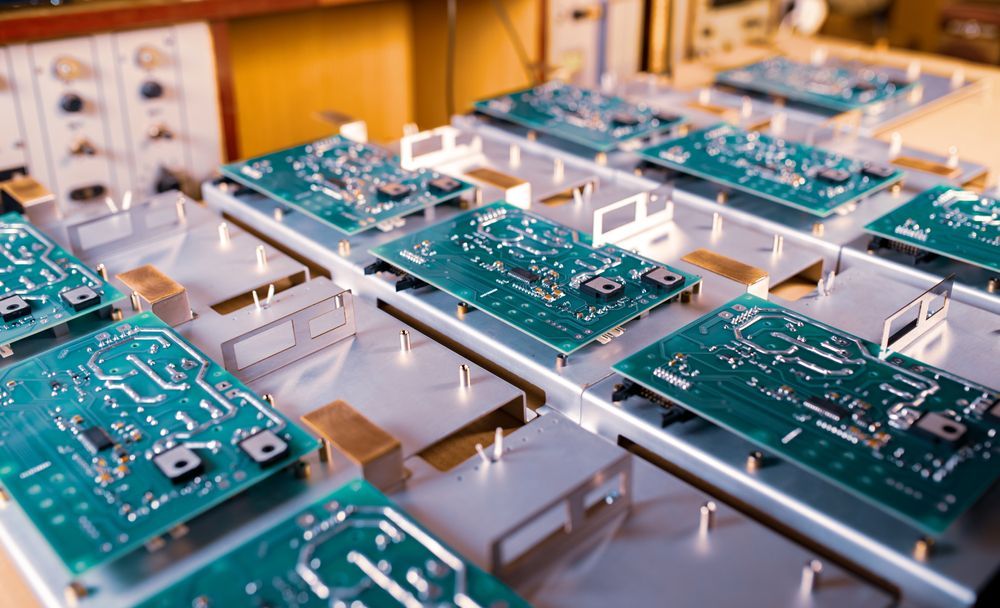
For medical, aerospace, industrial, and other high-reliability electronics, reflow consistency has consequences beyond first-pass yield. A head-in-pillow defect can lead to rework, additional inspection, production delays, or reliability concerns after an assembly enters service. Vapor phase reflow helps control this risk by reducing thermal gradients and promoting consistent solder joint formation across complex boards.
EI Sales connects engineering teams with
PCB assembly services and manufacturing resources from prototype through production. Its solutions-oriented approach brings PCB fabrication, assembly, testing, components, and engineering resources together around the needs of the application. When dense layouts, challenging BGAs, or high thermal mass complicate production, EI Sales focuses on providing solutions that move designs toward repeatable manufacturing.
Contact us to discuss your PCB assembly requirements and expect solutions.